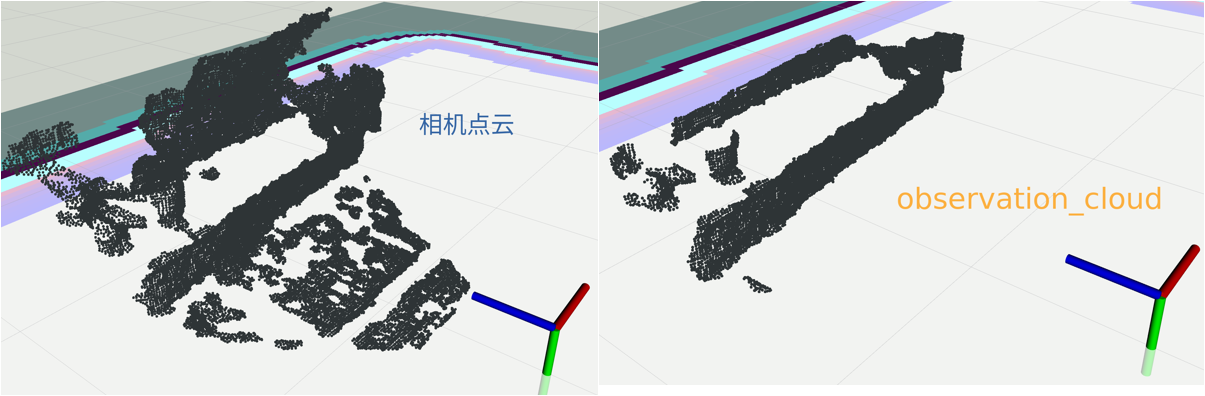
有一次机器人没有装雷达和相机,打算随便跑跑。于是在通用代价地图的障碍层,不设置传感器数据来源,运行move_base出现频繁报警1
The /scan observation buffer has not been updated for 22.06 seconds, and it should be updated every 5.00 seconds.
来源在1
2
3
4
5
6
7
8
9
10
11
12
13
14bool ObservationBuffer::isCurrent() const
{
if (expected_update_rate_ == ros::Duration(0.0))
return true;
// last_updated_ 没有赋值
bool current = (ros::Time::now() - last_updated_).toSec() <= expected_update_rate_.toSec();
if (!current)
{
ROS_WARN(
"The %s observation buffer has not been updated for %.2f seconds, and it should be updated every %.2f seconds.",
topic_name_.c_str(), (ros::Time::now() - last_updated_).toSec(), expected_update_rate_.toSec());
}
return current;
}
此时发导航命令,又有报警1
[/move_base]:Sensor data is out of date, we're not going to allow commanding of the base for safety
因为没有可靠的传感器数据,move_base不允许车跑起来。来源在MoveBase::executeCycle1
2
3
4
5
6if(!controller_costmap_ros_->isCurrent())
{
ROS_WARN("[%s]:Sensor data is out of date, we're not going to allow commanding of the base for safety",ros::this_node::getName().c_str());
publishZeroVelocity();
return false;
}
也就是函数1
2
3
4
5
6
7
8
9bool LayeredCostmap::isCurrent()
{
current_ = true;
for (vector<boost::shared_ptr<Layer> >::iterator plugin = plugins_.begin(); plugin != plugins_.end();
++plugin)
{
current_ = current_ && (*plugin)->isCurrent();
}
}
显然是因为障碍层不符合isCurrent,导致代价地图也不符合isCurrent。如果希望车照样跑,就把MoveBase::executeCycle那段注释掉,把ObservationBuffer::isCurrent()的报警也注释掉,否则没完没了。
从网上下载一个包含雷达数据的bag,又设置了通用代价地图和tf树后,发现报警依然,应该还是时间戳问题,懒得再对齐了。
Packages, Topics / Services, 文件、库的命名都采用 under_scored
Classes / Types的命名采用 CamelCased,比如class ExampleClass, class HokuyoURGLaser。 函数命名采用 camelCased,比如int exampleMethod(int example_arg)
普通变量和成员变量命名、命名空间都使用 under_scored,循环中的临时变量使用i,j,k,i on the outer loop, j on the next inner loop
常量命名采用 ALL_CAPITALS
全局变量采用 g_ 开头的 under_scored
每行最多120个字符
所有头文件要包含#ifndef,比如:
1 |
|
这部分应该在license之后,#endif在头文件的最后
预处理所用的宏,比如1
2
3
temporary_debugger_break();
函数的输出参数使用指针,而不是引用: int exampleMethod(FooThing input, BarThing* output);
头文件里不要用using namespace关键字,在源文件里可使用using,但不要using namespace std;,而是使用using std::list;, using std::vector;,否则引入了std所有内容。
建议使用Exceptions,而不是returning integer error codes。 析构函数不要抛出异常。 不直接触发的回调函数,不要抛出异常。
保证代码是 exception-safe: When your code can be interrupted by exceptions, you must ensure that resources you hold will be deallocated when stack variables go out of scope. In particular, mutexes must be released, and heap-allocated memory must be freed. Accomplish this safety by using the following mutex guards and smart pointers
1 | namespace Choices |
This prevents enums from polluting the namespace they’re inside. Individual items within the enum are referenced by: Choices::Choice1, but the typedef still allows declaration of the Choice enum without the namespace.
1 | enum class Choice |
不建议使用全局变量和函数,尤其前者。更不能在多线程中使用。大多数变量和函数都该在类的体内,其他应当在命名空间里。
类不要使用静态变量。
只在 well-defined exit point 调用exit()函数
使用assertions之类的比条件判断语句好,比如ROS_ASSERT, ROS_ASSERT_MSG, ROS_ASSERT_CMD, ROS_BREADK
Depending on compilation settings, the assertion may not be executed.
It is typical to develop software with assertion-checking enabled, in order to catch violations. When nearing software completion and when assertions are found to always be true in the face of extensive testing, you build with a flag that removes assertions from compilation, so they take up no space or time.
The following option to catkin_make will define the NDEBUG macro for all your ROS packages, and thereby remove assertion checks.catkin_make -DCMAKE_CXX_FLAGS:STRING="-DNDEBUG"
Note: cmake will rebuild all your software when you run it with this command, and will remember the setting through subsequent catkin_make runs until you delete your build and devel directories and rebuild.
1 |
|
cmake 中判断CPU 架构,操作系统类型1
2
3
4
5
6
7
8
9
10
11
12
13
14
15cmake_minimum_required(VERSION 3.10.0)
message(${CMAKE_HOST_SYSTEM_NAME})
message(${CMAKE_HOST_SYSTEM_PROCESSOR})
if(CMAKE_HOST_SYSTEM_NAME MATCHES "Linux")
message("this is Linux")
elseif(CMAKE_HOST_SYSTEM_NAME MATCHES "Windows")
message("this is Windows")
endif()
if(CMAKE_HOST_SYSTEM_PROCESSOR MATCHES "aarch64")
message("this is aarch64 cpu")
elseif(CMAKE_HOST_SYSTEM_PROCESSOR MATCHES "x86_64")
message("this is x86_64 cpu")
endif()
根据编译器的情况,有下面的宏用于调试程序:1
2
3
4
5
6
7
8
9
10
11
12
13
14
15//判断是不是C++环境,需要注意的是ROS环境中这里为否
printf("C++\n");
//判断是不是C环境
printf("C\n");
//输出语句所在函数,行,文件等参数
printf("function %s: Line 25\n",__func__); //或者用__FUNCTION__
printf("pretty function %s: Line 25\n",__PRETTY_FUNCTION__); //函数声明,包括了参数
printf("line: %d\n",__LINE__);
printf("current file: %s\n",__FILE__);
printf("date: %s\n",__DATE__);
printf("time: %s\n",__TIME__);
源码其实并不复杂1
2
3
4
5
6
7
8
9
10
11
12
13
14
15
16
17
18
19
20
21
22
23
24
25
26
27
28
29
30
31
32
33
34
35
36
37bool Costmap2DROS::getRobotPose(tf::Stamped<tf::Pose>& global_pose) const
{
global_pose.setIdentity();
tf::Stamped < tf::Pose > robot_pose;
robot_pose.setIdentity();
robot_pose.frame_id_ = robot_base_frame_;
robot_pose.stamp_ = ros::Time();
ros::Time current_time = ros::Time::now(); // save time for checking tf delay later
try
{
tf_.transformPose(global_frame_, robot_pose, global_pose);
}
catch (tf::LookupException& ex)
{
ROS_ERROR_THROTTLE(1.0, "No Transform available Error looking up robot pose: %s\n", ex.what());
return false;
}
catch (tf::ConnectivityException& ex)
{
ROS_ERROR_THROTTLE(1.0, "Connectivity Error looking up robot pose: %s\n", ex.what());
return false;
}
catch (tf::ExtrapolationException& ex)
{
ROS_ERROR_THROTTLE(1.0, "Extrapolation Error looking up robot pose: %s\n", ex.what());
return false;
}
// check global_pose timeout
if (current_time.toSec() - global_pose.stamp_.toSec() > transform_tolerance_)
{
ROS_WARN_THROTTLE(1.0,
"Costmap2DROS transform timeout. Current time: %.4f, global_pose stamp: %.4f, tolerance: %.4f",
current_time.toSec(), global_pose.stamp_.toSec(), transform_tolerance_);
return false;
}
return true;
}
核心是函数 transformPose,tf_在这里是tf::TransformListener,但函数实际是继承自基类tf::Transformer,有两个重载,常用的是第一个1
2
3
4
5
6
7
8
9
10
11void Transformer::transformPose(const std::string& target_frame,
const Stamped< tf::Pose >& stamped_in,
Stamped< tf::Pose >& stamped_out
) const
void Transformer::transformPose(const std::string& target_frame,
const ros::Time& target_time,
const Stamped< tf::Pose >& stamped_in,
const std::string& fixed_frame,
Stamped< tf::Pose >& stamped_out
) const
第二个重载会调用函数lookupTransform1
2
3
4
5
6
7
8// Get the transform between two frames by frame ID assuming fixed frame.
void Transformer::lookupTransform ( const std::string & target_frame,
const ros::Time & target_time,
const std::string & source_frame,
const ros::Time & source_time,
const std::string & fixed_frame,
StampedTransform & transform
) const
可能抛出的异常1
2
3
4
5
6
7
8namespace tf{
// Pass through exceptions from tf2
typedef tf2::TransformException TransformException;
typedef tf2::LookupException LookupException;
typedef tf2::ConnectivityException ConnectivityException;
typedef tf2::ExtrapolationException ExtrapolationException;
typedef tf2::InvalidArgumentException InvalidArgument;
}
报警对应的transform_tolerance_是在构造函数里写死的0.3,一开始我以为这个数太小了,于是改为2,结果没有改善。
以下报警的根源都是Costmap2DROS::getRobotPose

尝试的改善措施(全都无效):
Costmap2DROS构造函数中设置: transform_tolerance_(2)timer_ = private_nh.createTimer(ros::Duration(.1), &Costmap2DROS::movementCB, this); 0.1秒间隔太短了。增大到1.5,稍有改善,但未解决根本问题,反而降低了代价地图的性能。update_frequency所有报警基本来自Costmap2DROS::getRobotPose,或者说map—->base_link的tf变换不及时。
xv_sdk.launch,使用static_transform_republisher建立假的TF树,启动导航框架,一个报警也没有。因此问题还在VSLAM,怀疑是CPU而不是网络问题。xv_sdk.launch和VSLAM,但不发布tf,使用假的tf树,启动导航框架,仍然没有报警。world—->map—->odom—-> base_link,导航框架不报警。但是如果由VSLAM发布map—->odom,就有报警了。所以问题的原因:
map—->odom—-> base_link变换。在此情况下规划路径时,全局路径可生成,因为全局规划频率是0,虽然有很多报警,总能成功规划一次。但局部路径就不同了,需要频繁规划。
只看TF的频率和tf echo有没有数据还不够,应该看Rviz里,base_link坐标系在map中的坐标是否能随着机器人的移动实时更新。先满足这一点,再运行导航框架。
头文件1
2
3
4
5
6
open函数默认是读模式。
写bag文件:1
2
3
4
5
6
7
8
9
10rosbag::Bag bag;
try{
bag.open("/home/user/plan.bag", rosbag::bagmode::Write);
}
catch (const rosbag::BagException& ex) {
ROS_ERROR("open rosbag error: %s", ex.what() );
return;
}
bag.write("record_plan",ros::Time::now(), coverage_plan);
bag.close();
打开文件的模式有:enum rosbag::bagmode::BagMode1
2
3Write
Read
Append
读bag文件一定要用try和catch
下面的例子,bag文件只有一个话题/move_base/transformed_plan,一堆nav_msgs/Path消息1
2
3
4
5
6
7
8
9
10
11
12
13
14
15
16
17
18
19
20
21
22
23
24
25
26
27
28
29
30rosbag::Bag bag;
try{
bag.open("/home/user/plan.bag", rosbag::bagmode::Read);
}
catch (const rosbag::BagException& ex) {
ROS_ERROR("open rosbag error: %s", ex.what() );
return;
}
std::vector<std::string> topics;
bool bag_read_once = false;
topics.push_back(std::string("record_plan") );
rosbag::View view(bag, rosbag::TopicQuery(topics) );
BOOST_FOREACH(rosbag::MessageInstance const m, view)
{
nav_msgs::Path::ConstPtr i = m.instantiate<nav_msgs::Path>();
plan_from_bag.header.frame_id = i->header.frame_id;
plan_from_bag.header.stamp = i->header.stamp;
plan_from_bag.header.seq = i->header.seq;
unsigned int path_size = i->poses.size();
ROS_INFO("plan from bag size: %zu",i->poses.size() );
plan_from_bag.poses.reserve(path_size);
if(bag_read_once) break;
plan_from_bag.poses = i->poses;
bag_read_once = true;
}
bag.close();
注意读的时候,topics容器的元素必须还是number,与写文件时一致。如果不一致,读文件会不执行foreach
用到的类如下:1
2
3
4
5
6
7
8
9
10
11
12
13
14
15
16
17
18
19
20
21/* Create a view and add a query
* param bag The bag file on which to run this query
* param query The actual query to evaluate which connections to include
* param start_time The beginning of the time range for the query
* param end_time The end of the time range for the query
* param reduce_overlap If multiple views return the same messages, reduce them to a single message
*/
View(Bag const& bag, boost::function<bool(ConnectionInfo const*)> query,
ros::Time const& start_time = ros::TIME_MIN, ros::Time const& end_time = ros::TIME_MAX, bool const& reduce_overlap = false);
class ROSBAG_DECL TopicQuery
{
public:
TopicQuery(std::string const& topic);
TopicQuery(std::vector<std::string> const& topics);
bool operator()(ConnectionInfo const*) const;
private:
std::vector<std::string> topics_;
};
rosbag::View的常用函数
iterator begin() Simply copy the merge_queue state into the iterator.iterator end() Default constructed iterator signifies end.ros::Time getBeginTime()ros::Time getEndTime()uint32_t size () 获得bag文件中所含消息的个数,不是文件大小其他常用函数1
2
3
4
5
6
7// Get the filename of the bag
std::string getFileName () const
// Get the current size of the bag file (a lower bound) More...
uint64_t getSize () const
bool isOpen () const

这种情况下如果没有用try和catch就会出错
我查来查去,没发现C++ API里有类似rosbag reindex命令的函数,只能不处理。似乎python里有,没有深入研究,
参考:
rosbag API
Costmap2DROS类是2D Costmap的ROS封装类,处理订阅的话题,这些话题提供了对障碍物的观测,方式为点云或激光扫描消息。 costmap_2d::Costmap2DROS给用户提供了纯2D的接口,这意味着查询障碍只能在列上进行。例如,在XY平面上位于同一位置的桌子和鞋,虽然在Z方向上有差异但是它们在costmap_2d::Costmap2DROS对象代价地图中对应的cell上拥有相同的代价值。
A ROS wrapper for a 2D Costmap. Handles subscribing to topics that provide observations about obstacles in either the form of PointCloud or LaserScan messages.
实际是return layered_costmap_->getCostmap();,跟getLayeredCostmap()->getCostmap()一样. Return a pointer to the “master” costmap which receives updates from all the layers.1
costmap_2d::Costmap2D* global_costmap = planner_costmap_ros_->getCostmap();
获取机器人在代价地图的global frame中的位姿,成功获取则返回true1
2
3
4
5
6
7
8
9
10
11// 这个返回类型很不方便
tf::Stamped<tf::Pose> pose;
if(!costmap->getRobotPose(pose))
{
ROS_ERROR("Cannot clear map because pose cannot be retrieved");
return;
}
double x = pose.getOrigin().x();
double y = pose.getOrigin().y();
double yaw = tf::getYaw(pose.getRotation());
double yaw_norm = angles::normalize_angle(tf::getYaw(pose.getRotation() ) );
对于全局代价地图,一般是返回在map坐标系下的位姿,对于局部代价地图,一般是在odom或者map下的位姿。
Costmap2DROS::getRobotPose函数调用分析
这两个返回的就是代价地图yaml里配置的全局和局部坐标系
LayeredCostmap* getLayeredCostmap()
std::vector<geometry_msgs::Point> getRobotFootprint() 获取机器人边界(在机器人坐标系下,包含padding),返回的是vector<geometry_msgs::Point>,索引顺序就是yaml中设置的顺序
std::vector<geometry_msgs::Point>getUnpaddedRobotFootprint() 获取机器人边界(在机器人坐标系下,不包含padding)
geometry_msgs::Polygon getRobotFootprintPolygon() 获取机器人边界(在机器人坐标系下,包含padding)
LayeredCostmap类是Costmap2DROS的类成员,它是主地图,也能够管理各层地图,因为它含有指向各层子地图的指针,能够调用子地图的类方法,开启子地图的更新。 每一层在Costmap2DROS中以插件方式被实例化,并被添加到LayeredCostmap。每一层可以独立编译,且可使用C++接口对代价地图随意修改,即LayerdCostmap为Costmap2DROS(用户接口)提供了加载地图层的插件机制,每个插件(即地图层)都是Layer类型的
LayeredCostmap的所有函数其实都是通过Costmap2D和各个Layer的函数执行的。
Layer调用的函数: isCurrent, onFootprintChanged, updateBounds, matchSize
Costmap2D调用的函数: updateOrigin, resizeMap, setDefaultValue
getCostmap()也可以获得costmap_2d::Costmap2D *costmap指针
getInscribedRadius() 获得内切圆半径
getCircumscribedRadius() 获得外接圆半径
地图有效性 current
对于各层,都有current_参数,该参数继承自Layer类,且通过Layer::isCurrent查询。总的地图的current是通过各层current的与操作计算出来的, 可看LayeredCostmap::isCurrent(),主要的操作是对操作的实时性提供保证,提供是否发生超时的信息。
对于静态层,只要初始化(onInitialize)完成后current_就一直为true
对于障碍物层,其current_参数是各个观察缓冲区ObservationBuffer是否current的与操作,而ObservationBuffer的current取决于缓冲区更新时间(新的观测数据到来的时间)与expected_update_rate参数的对比。
对于膨胀层,也是只要初始化完成后current_就一直为true
1 | bool Costmap2D::setConvexPolygonCost(const std::vector<geometry_msgs::Point>& polygon, unsigned char cost_value) |
这个函数用于获取多边形边缘及内部cell1
2
3
4
5
6
7
8
9
10
11
12
13
14
15
16
17
18
19
20
21
22
23
24
25
26
27
28
29
30
31
32
33
34
35
36
37
38
39
40
41
42
43
44
45
46
47
48
49
50
51
52
53
54
55
56
57
58
59
60
61
62
63
64
65
66
67
68
69
70
71
72
73void Costmap2D::convexFillCells(const std::vector<MapLocation>& polygon, std::vector<MapLocation>& polygon_cells)
{
// we need a minimum polygon of a triangle
if (polygon.size() < 3)
return;
// first get the cells that make up the outline of the polygon
//首先获得轮廓点之间连线的列表,存放在polygon_cells中
polygonOutlineCells(polygon, polygon_cells);
// quick bubble sort to sort points by x
MapLocation swap;
unsigned int i = 0;
// 对边上的cell点的x做排序,使其按x坐标升序排列
while (i < polygon_cells.size() - 1)
{
if (polygon_cells[i].x > polygon_cells[i + 1].x)
{
swap = polygon_cells[i];
polygon_cells[i] = polygon_cells[i + 1];
polygon_cells[i + 1] = swap;
if (i > 0)
--i;
}
else
++i;
}
/* 遍历所有x,对每个相同的x,检查y,获得y最大和最小的polygon cell,
将范围内的所有cell填充进polygon_cells,获得多边形边缘及内部的所有cell */
i = 0;
MapLocation min_pt;
MapLocation max_pt;
unsigned int min_x = polygon_cells[0].x;
unsigned int max_x = polygon_cells[polygon_cells.size() - 1].x;
// walk through each column and mark cells inside the polygon
for (unsigned int x = min_x; x <= max_x; ++x)
{
if (i >= polygon_cells.size() - 1)
break;
if (polygon_cells[i].y < polygon_cells[i + 1].y)
{
min_pt = polygon_cells[i];
max_pt = polygon_cells[i + 1];
}
else
{
min_pt = polygon_cells[i + 1];
max_pt = polygon_cells[i];
}
i += 2;
while (i < polygon_cells.size() && polygon_cells[i].x == x)
{
if (polygon_cells[i].y < min_pt.y)
min_pt = polygon_cells[i];
else if (polygon_cells[i].y > max_pt.y)
max_pt = polygon_cells[i];
++i;
}
MapLocation pt;
// loop though cells in the column
for (unsigned int y = min_pt.y; y < max_pt.y; ++y)
{
pt.x = x;
pt.y = y;
polygon_cells.push_back(pt);
}
}
}
循环调用raytraceLine函数,不断获取相邻之间的连线,最终组成多边形边上的cell,需要注意的是需要将最后一点和第一点连接起来,形成闭合。1
2
3
4
5
6
7
8
9
10
11
12
13
14void Costmap2D::polygonOutlineCells(const std::vector<MapLocation>& polygon, std::vector<MapLocation>& polygon_cells)
{
PolygonOutlineCells cell_gatherer(*this, costmap_, polygon_cells);
for (unsigned int i = 0; i < polygon.size() - 1; ++i)
{
raytraceLine(cell_gatherer, polygon[i].x, polygon[i].y, polygon[i + 1].x, polygon[i + 1].y);
}
if (!polygon.empty())
{
unsigned int last_index = polygon.size() - 1;
// we also need to close the polygon by going from the last point to the first
raytraceLine(cell_gatherer, polygon[last_index].x, polygon[last_index].y, polygon[0].x, polygon[0].y);
}
}
找到两点连线上的cell。对于离散的平面点,指定两个点,这个函数可以找到两个点之间的其他点,使得这些中间组成一个尽可能趋近直线的点集1
2
3
4
5
6
7
8
9
10
11
12
13
14
15
16
17
18
19
20
21
22
23
24
25
26
27
28
29
30
31template<class ActionType> inline void raytraceLine(ActionType at,
unsigned int x0, unsigned int y0,
unsigned int x1, unsigned int y1,
unsigned int max_length = UINT_MAX )
{
int dx = x1 - x0;
int dy = y1 - y0;
unsigned int abs_dx = abs(dx);
unsigned int abs_dy = abs(dy);
int offset_dx = sign(dx);
int offset_dy = sign(dy) * size_x_;
unsigned int offset = y0 * size_x_ + x0;
// we need to chose how much to scale our dominant dimension, based on the maximum length of the line
double dist = hypot(dx, dy);
double scale = (dist == 0.0) ? 1.0 : std::min(1.0, max_length / dist);
// if x is dominant
if (abs_dx >= abs_dy)
{
int error_y = abs_dx / 2;
bresenham2D(at, abs_dx, abs_dy, error_y, offset_dx, offset_dy, offset, (unsigned int)(scale * abs_dx));
return;
}
// otherwise y is dominant
int error_x = abs_dy / 2;
bresenham2D(at, abs_dy, abs_dx, error_x, offset_dy, offset_dx, offset, (unsigned int)(scale * abs_dy));
}