throw和catch
warning: catching polymorphic type ‘class std::exception’ by value [-Wcatch-value=] catch (std::exception e) {

这个警告是因为我们以值捕获的方式(byvalue)捕获了一个多态类型(polymorphic type)的异常(例如std:exception)。在 C++中,多态类型(即具有虚函数的类)通常应该通过引用(最好是const引用)来捕获,以避免对象切片(slicing)问题,并确保正确的多态行为。

代码中写了类似:catch(std:exception e) 按值捕获而正确的做法应该是:catch(const std:exception&e) ,按 const引用捕获

编译器选项—Wcatch—value(被—Wall启用)会对此发出警告,并且有三个级别:—Wcatch—value=1:警告按值捕获多态类型(默认,相当于—Wcatch—value)—Wcatch—value=2:警告按值捕获所有类类型—Wcatch—value=3:警告所有没有通过引用捕获的类型因此,解决这个警告的方法就是将按值捕获改为按引用捕获。


行为树两个Exception

  • LogicError is related to problems which require code refactoring to be fixed.

  • RuntimeError is related to problems that are relted to data or conditions that happen only at run-time

createTree之后的 catch 应该这样用:

1
2
3
4
5
6
7
8
9
10
11
12
13
14
15
BT::Tree  tree;
try{
factory.registerBehaviorTreeFromFile("/home/user/test.xml");
tree = factory.createTree("maintree", maintree_bb);
} catch (BT::RuntimeError &error) {
printf("behavior tree RuntimeError: %s", error.what() );
return false;
} catch (BT::LogicError &error) {
printf("behavior tree LogicError: %s", error.what() );
return false;
}
catch (...) {
printf("create behavior tree failed, check it out");
return false;
}


ROS2自定义msg, action, srv

ROS2中msg的命名规范:必须以大写字母开头,并且不能有下划线,应当是 ^[A-Z][A-Za-z0-9]*$。像moving_target.msg, Moving_target.msg都是不规范的,应该是MovingTarget.msg

msg文件里的成员命名:只能是小写+下划线,不能出现大写。int32 id_number是合适的,int32 ID_number就不合适

参考 官方教程,注意对package.xml做下面修改

1
2
3
<build_depend>rosidl_default_generators</build_depend>
<exec_depend>rosidl_default_runtime</exec_depend>
<member_of_group>rosidl_interface_packages</member_of_group>

在其他包使用自定义的msg/Action包的时候,编译完成后,去build文件夹里找到可执行文件,结果发现有一个.so没有链接成功

1
2
3
ldd libmy_node.so  | grep my_defined
libmy_defined_msgs__rosidl_typesupport_cpp.so => /home/user/j36_project/install/my_defined_msgs/lib/libmy_defined_msgs__rosidl_typesupport_cpp.so (0x00007a9426d69000)
libmy_defined_msgs__rosidl_generator_c.so => not found

如果直接运行会出错,但如果用ros2 run运行是正常的,应当是ROS2运行时会建立链接,应当是ament命令在运行期发挥了作用


roslaunch的写法

launch目录里创建launch文件或py文件后,ros2 launch不能直接找到,会报错

1
file 'file.launch' was not found in the share directory of package 'package_name' which is at '/home/user/catkin_ws/install/package_name/share/package_name'

需要在CMakeLists里加一句
1
2
install(DIRECTORY launch
DESTINATION share/${PROJECT_NAME})

再编译后,会把launch文件复制到share目录里。

  • 使用xml
1
2
3
4
5
6
7
8
<launch>
<node pkg="nav2_map_server" exec="map_server" name="map_server">
<param name="yaml_filename" value="/home/zzp/catkin_ws/maps/test.yaml"/>
</node>

<node pkg="nav2_planner" exec="planner_server" name="planner_server" >
</node>
</launch>

args的写法一直查不到,按ROS1的写法是错的,节点会退出: <node pkg ="tf2_ros" exec="static_transform_publisher" name="map_odom_tf" args="1 0 0 0 0 0 map odom 100" />

  • 使用python
1
2
3
cd ~/ros2_ws
mkdir launch
vim launch/both_launch.py

加入下面内容:

1
2
3
4
5
6
7
8
9
10
11
12
13
14
15
16
17
18
from launch import LaunchDescription
from launch_ros.actions import Node

def generate_launch_description():
return LaunchDescription([
Node(
package='duckiebot',
namespace='duckietown',
executable='duckiebot_node',
name='duckiebot_node1'
),
Node(
package='control',
namespace='duckietown',
executable='control_node',
name='control_node1'
)
])


不同命名空间的两个类互相调用

两个类互相引用的问题,一般用前置声明解决,但是两个不同命名空间的类就有些复杂了,两个类的头文件和源文件这样写:

类A的头文件:

1
2
3
4
5
6
7
8
9
10
11
12
13
14
15
namespace bbb
{
class B;
}

namespace aaa {

class A
{
public:
A();
private:
bbb::B* b;
};
}

类A的源文件
1
2
3
4
5
6
7
8
9
#include "a.h"
#include "b.h"

namespace aaa {
A::A()
{
cout << "A" << endl;
}
}

类B的头文件:

1
2
3
4
5
6
7
8
9
10
11
#include "a.h"

namespace bbb {
class B
{
public:
B();
private:
aaa::A* a;
};
}

类B的源文件

1
2
3
4
5
6
7
8
#include "b.h"

namespace bbb {
B::B()
{
cout << "B" << endl;
}
}

1
2
3
4
5
file.cc:19:69:   required from here
/usr/include/c++/13/ext/aligned_buffer.h:93:28: error: invalid application of ‘sizeof’ to incomplete type ‘aaa::A’
93 | : std::aligned_storage<sizeof(_Tp), __alignof__(_Tp)>
| ^~~~~~~~~~~
/usr/include/c++/13/ext/aligned_buffer.h:93:28: error: invalid application of ‘sizeof’ to incomplete type ‘aaa::A’

解决了带命名空间的两个类互相调用的问题后,编译又出错误。看来是初始化aaa::A时,sizeof计算出错

前置声明告知编译器某个类或者模板的存在,但不提供其完整定义的方式。在初始化前置声明类时,需要分配内存,也就需要使用sizeof,它的计算发生在代码编译时期,此时无法计算,就会报错。解决方法就是在源文件里include前置声明类的头文件,比如这里我们在b.cppinclude "a.h"


BehaviorCPP版本从3到4.6的变化

可以使用convert_v3_to_v4.py将版本3的xml文件转为版本4,没发现反过来转换的。

  • classes / XML tags 发生的变化
Name in 3.8+ Name in 4.x Where
NodeConfiguration NodeConfig C++
SequenceStar SequenceWithMemory C++ and XML
AsyncActionNode ThreadedAction C++
BT::Optional BT::Expected C++
  • <root> 变成了 <root BTCPP_format="4">

  • ControlNodes and Decorators 必须支持新的节点状态 NodeStatus:SKIPPED

The purpose of this new status is to be returned when a PreCondition is not met. When a Node returns SKIPPED, it is notifying to its parent (ControlNode or Decorator) that it hasn’t been executed.

  • Ticking in a While Loop

版本3常常是这样进行tick的

1
2
3
4
5
while(status != NodeStatus::SUCCESS || status == NodeStatus::FAILURE)
{
tree.tickRoot();
std::this_thread::sleep_for(sleep_ms);
}

版本4引入新的sleep函数

1
Tree::sleep(std::chrono::milliseconds timeout)

This particular implementation of sleepcan be interrupted if any node in the tree invokes the method TreeNode::emitWakeUpSignal. This allows the loop to re-tick the tree immediately.

Tree::tickRoot() 已经消失了

1
2
3
4
5
6
7
8
//  status = tree.tickOnce();
while(!BT::isStatusCompleted(status) )
{
//---- or, even better ------
// tree.tickWhileRunning(sleep_ms);
tree.tickOnce();
tree.sleep(sleep_ms);
}

Tree::tickWhileRunning is the new default and it has its own internal loop; the first argument is a timeout of the sleep inside the loop.

或者这两个:

  • Tree::tickExactlyOnce(): equivalent to the old behavior in 3.8+
  • Tree::tickOnce() is roughly equivalent to tickWhileRunning(0ms). It may potentially tick more than once.
  • getInput的变化
1
BT::Optional<std::string> port_plugin_name = getInput<std::string>("plugin_name");

原型: Result BT::TreeNode::getInput(const std::string& key, T& destination ) const [inline]

Read an input port, which, in practice, is an entry in the blackboard. If the blackboard contains a std::string and T is not a string, convertFromString<T>() is used automatically to parse the text.

如果没有默认值的InputPort,不能获取值,运行会报错

1
2
3
BT::Expected<int> t = getInput<int>("ttt");
if(t)
cout << "Expected ttt: " << t.value() << endl;
  • SequenceWithMemory 取代 SequenceStar

Use this ControlNode when you don’t want to tick children again that already returned SUCCESS.

加载行为树的方式变化

1
2
3
4
5
6
7
Tree BT::BehaviorTreeFactory::createTree(const std::string& tree_name,
Blackboard::Ptr blackboard = Blackboard::create() )

Tree BT::BehaviorTreeFactory::createTreeFromFile(const std::string& file_path, Blackboard::Ptr blackboard = Blackboard::create() )

Tree BT::BehaviorTreeFactory::createTreeFromText(const std::string& text,
Blackboard::Ptr blackboard = Blackboard::create() )


1
- void BT::BehaviorTreeFactory::registerBehaviorTreeFromFile(const std::string&  filename)

Load the definition of an entire behavior tree, but don’t instantiate it. You can instantiate it later with BehaviorTreeFactory::createTree(tree_id), where “tree_id” come from the XML attribute <BehaviorTree id="tree_id">

1
void BT::BehaviorTreeFactory::registerBehaviorTreeFromText(const std::string &_xml_text_)

Same of registerBehaviorTreeFromFile, but passing the XML text, instead of the filename

  • 版本3的用法

auto tree = factory.createTreeFromFile("test.xml", maintree_bb);

版本4的用法如下:

1
2
3
4
factory.registerBehaviorTreeFromFile("test.xml");

// xml文件的开头是 <root BTCPP_format="4" main_tree_to_execute = "test" >
auto tree = factory.createTree("test", maintree_bb);

main_tree_to_execute的值一定要和createTree的第一个参数一致,否则会出错,出错的根源在 Tree XMLParser::instantiateTree(const Blackboard::Ptr& root_blackboard, std::string main_tree_ID)

每次在Groot2里修改行为树后,保存会让main_tree_to_execute部分消失,我认为这是个设计上的bug

tick系列函数

  • 版本4不再有函数 BT::Tree::tickRoot(TickOption opt, std::chrono::milliseconds sleep_time)
1
2
3
4
5
6
7
enum BT::Tree::TickOption
{
Enumerator
EXACTLY_ONCE
ONCE_UNLESS_WOKEN_UP
WHILE_RUNNING
}

版本4使用下面3个函数

  • BT::NodeStatus BT::Tree::tickWhileRunning(std::chrono::milliseconds sleep_time = std::chrono::milliseconds(10) )

Call tickOnce until the status is different from RUNNING. Note that between one tick and the following one, a Tree::sleep() is used

  • BT::NodeStatus BT::Tree::tickExactlyOnce()

Tick the root of the tree once, even if a node invoked emitWakeUpSignal()

  • BT::NodeStatus BT::Tree::tickOnce()

by default, tickOnce() sends a single tick, But as long as there is at least one node of the tree invoking TreeNode::emitWakeUpSignal(), it will be ticked again.


BT::Tree在版本3里有两个成员变量

1
2
3
std::vector<Blackboard::Ptr>  blackboard_stack

std::vector<TreeNode::Ptr> nodes

在版本4里这两个都消失了,增加了成员std::vector<Subtree::Ptr> subtrees,可能会造成不便。


Gazebo Harmonic 配置仿真环境

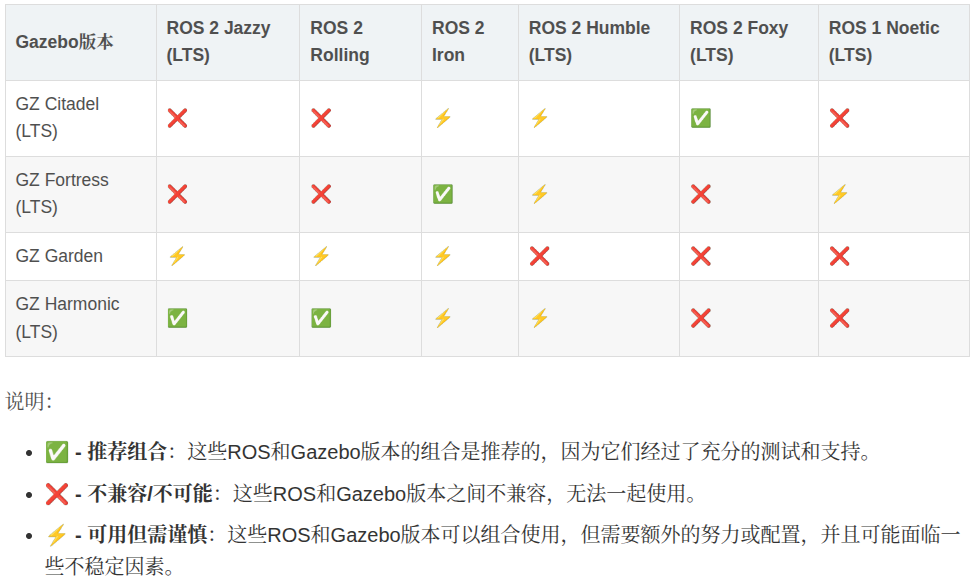
按照这个包的步骤来,最后启动

1
ros2 launch gazebo_differential_drive_robot robot.launch.py

手动控制还是用cmd


Gazebo Harmonic 安装和常用命令

ubuntu 24.04安装jazzy后,对应的gazebo和以前不太一样了。我们需要安装的是 gazebo Harmonic

image.png

安装

安装过程参考 Gazebo Harmonic 和 ROS2 jazzy 安装和测试

最后还要安装

1
2
3
4
5
6
7
8
9
10
sudo apt-get install -y ros-jazzy-ros-gz 
sudo apt-get install -y ros-jazzy-ros-gz-sim-demos
sudo apt-get install -y ros-jazzy-ros-gz-bridge
sudo apt-get install -y ros-jazzy-ros-gz-image
sudo apt-get install -y ros-jazzy-ros-gz-interfaces
sudo apt-get install -y ros-jazzy-ros-gz-sim
sudo apt-get install -y ros-jazzy-joint-state-publisher
sudo apt-get install -y ros-jazzy-xacro
sudo apt-get install -y ros-jazzy-teleop-twist-keyboard
sudo apt-get install -y ros-jazzy-teleop-twist-joy

基础命令

  • 启动命令: gz sim 或者 gz sim -v 4. -v: 指定日志详细级别,4 表示最高详细程度。

  • 可以使用-s(仅服务器)或-g(仅GUI)参数来分别运行服务器或GUI

插件的加载方式已被更改,需要在模型文件(SDF/URDF)或 Gazebo 的配置中添加。

  • 启动制定的sdf文件: gz sim shapes.sdf

启动之后,有3个进程: gz sim, gz sim server, gz sim gui

  • ROS2的方式启动: ros2 launch ros_gz_sim gz_sim.launch.py gz_args:=empty.sdf

  • 启动图像管道: ros2 launch ros_gz_sim_demos image_bridge.launch.py

重要的sdf文件: diff_drive_skid.sdf, actor.sdf

从ROS 2 Jazzy开始,Gazebo通过vendor包的形式在ROS包仓库中可用。如果您的包直接依赖于Gazebo库,而不是仅依赖于ros_gz,请参考相关文档学习如何使用Gazebo vendor包。

话题相关命令

gazebo的相关命令从ROS2里独立出来了

  • gz topic -l 显示所有话题

  • gz topic -it /model/tugbot/pose 显示话题信息,结果如下

1
2
3
Publishers [Address, Message Type]:
tcp://172.27.36.158:38969, gz.msgs.Pose
No subscribers on topic [/model/tugbot/pose]
  • -et echo 话题
  • -ft 显示话题频率
  • -pt 发布话题

gz topic -h可显示其他命令

在新的架构中,Gazebo Sim 与ROS 2的集成通过ros_gz桥接包实现。该桥接包允许 ROS 2 和 Gazebo Sim 之间的消息传递

问题

docker里运行gazebo报错: libGL error: MESA-LOADER: failed to retrieve device information ,这是本机的显卡没装好


AddressSanitizer(ASan)的使用

ASan 是GCC 和Clang 编译器的一部分,所以无需单独安装.

AddressSanitizer与Valgrind相比

  1. Valgrind通过模拟CPU来检测内存错误,导致会以较慢的速度运行程序;而AddressSanitizer是在编译阶段插入检查的逻辑,执行速度比Valgrind快很多
  2. Valgrind是一个独立的工具,可以使用在任何程序上;而AddressSanitizer与编译器紧密集成,可以在构建时自动启用
  3. 在错误信息的展示上,AddressSanitizer提供的错误信息比Valgrind容易理解,但Valgrind更详细
  4. AddressSanitizer作为编译器的一部分,通过编译选项启用;而Valgrind作为独立的工具,需要更多的配置和学习才能使用
  5. AddressSanitizer通过编译时插桩和运行时检查来检测内存错误,误报率较低

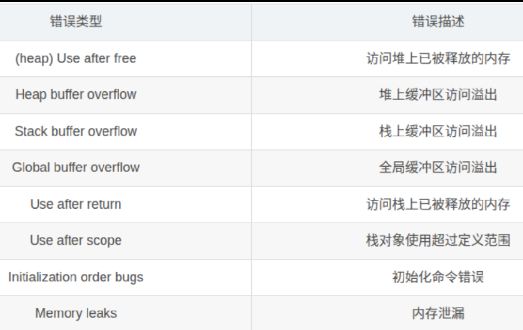
AddressSanitizer能检测的错误类型
截图 2025-07-09 09-35-44.png

CMake中的设置:

1
2
3
set(CMAKE_C_FLAGS "${CMAKE_C_FLAGS} -fsanitize=address")

set(CMAKE_CXX_FLAGS "${CMAKE_CXX_FLAGS} -fsanitize=address")

比如这样的典型代码

1
Test* t = new Test();

ASan的报错如下
1
2
3
4
5
6
7
8
9
10
11
12
13
14
15
16
17
=================================================================

==2816467==ERROR: LeakSanitizer: detected memory leaks

Direct leak of 8 byte(s) in 1 object(s) allocated from:

#0 0x72cdcdefe548 in operator new(unsigned long) ../../../../src/libsanitizer/asan/asan_new_delete.cpp:95

#1 0x5cbc2c68d2c3 in main /home/zzp/qt_projects/untitled/main.cpp:10

#2 0x72cdcd62a1c9 in __libc_start_call_main ../sysdeps/nptl/libc_start_call_main.h:58

#3 0x72cdcd62a28a in __libc_start_main_impl ../csu/libc-start.c:360

#4 0x5cbc2c68d1e4 in _start (/home/zzp/qt_projects/build-untitled-Desktop_Qt_5_9_9_GCC_64bit-Debug/untitled+0x21e4) (BuildId: 1061b9fe4580a7e3af28420ed615c3664d393550)

SUMMARY: AddressSanitizer: 8 byte(s) leaked in 1 allocation(s).


Groot的使用

Groot2 的缺陷

  1. 对一个控制节点,用Create Subtree创建子树后,无法恢复不是子树的状态。在左侧的树列表里,千万不要删除任何树,否则无法恢复
  2. 如果当前行为树设计有错,比如有多余节点,groot无法使用保存按钮,而且不提示哪里报错
  3. Switch最多有6个case,如果switch多设置了节点,Groot还不能报错
  4. 非Pro版本无法搜索节点,而且不能搜索节点的输入输出接口,注释等内容,只能按节点名称搜索
  5. 新建空文件 —-> 保存文件,结果出现对话框: Please initalize new files on the disk before saving the project。这个现象说明了groot这个软件设计非常失败,我从没见过有哪个软件新建一个文件后还不能直接保存的,更可笑的是初始化的单词都是错的。这么低级的缺陷都有,还好意思对pro版本收费?需要到左侧的根节点,右键save保存,以后才能用保存按钮。
  6. 有时打开一个文件时间长了,拖动时发现不是手形的光标了,变成普通光标
  7. 只有Ctrl+Z,没有Ctral+Y。使用时不太方便
  8. 资料太少,全靠自己摸索,一个并不复杂的问题,摸索一整天。

Groot跟Qt的UI模式相比,差距很大。前者只是个调试辅助工具,后者是工业级UI开发框架,不是一个档次。

Qt的UI和数据是绑定的,数据变化后,UI自动更新。Groot做不到,黑板变量变化,Groot看不到更新,说明它的 数据绑定 (Data Binding) 做得很差。

有些团队最后会自己用 Qt 重写一套调试UI,Groot只用来看行为树。

注意:Groot可以跨文件复制节点,跨版本也可以

Groot2

Real Time Monitor Mode

目前只有Groot2 Pro版本可以使用

在版本4里,BT::PublisherZMQ已经消失了。取而代之的是BT::Groot2Publisher,可以这样用

1
2
3
4
5
6
7
8
9
10
factory.registerBehaviorTreeFromFile("/home/user/test.xml");
auto tree = factory.createTree("test", maintree_bb);
// createTree之后,tick之前
BT::Groot2Publisher publisher(tree);

while (true)
{
tree.tickOnce();
tree.sleep(std::chrono::milliseconds(100) );
}
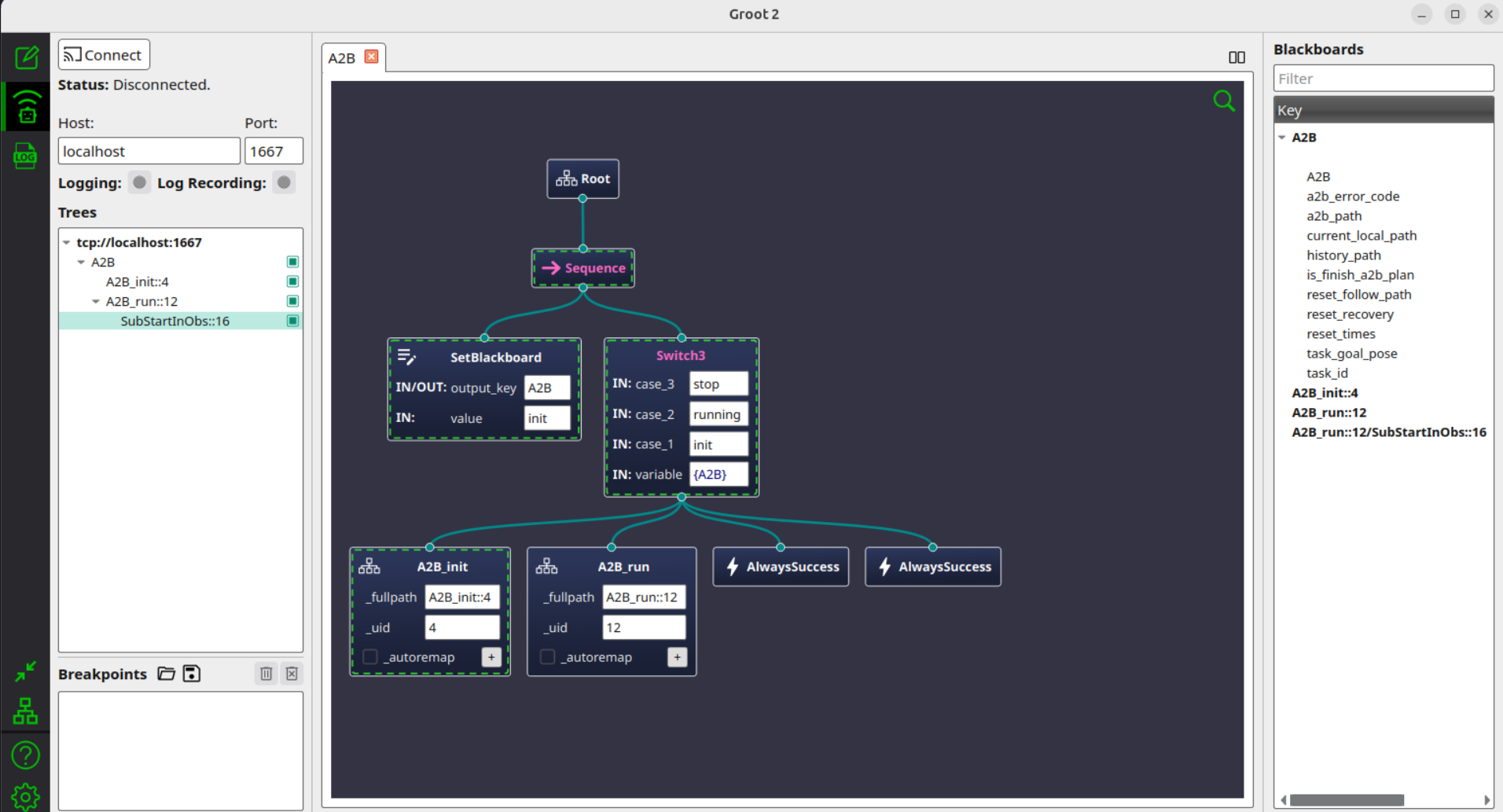
打开groot之后,点击Connect毫无反应,官方说明没有帮助,读源码发现构造函数里有默认端口号:Groot2Publisher(const BT::Tree& tree, unsigned server_port = 1667);

使用1667后就成功了。Host需要看情况作修改

截图 2025-07-05 16-40-03.png
参考: BT::Groot2Publisher Class Reference